Passwords. No one likes them, but everybody needs them. If you are concerned about your online safety, you probably have unique passwords for your critical accounts and some common pattern for all the almost-useless accounts you create when browsing the web.
At first I used to save my passwords in a gpg encrypted file. Over time however, I began using Firefox’s and Chrome’s password managers, mostly because of their awesome synching capabilities and form auto-filling.
Unfortunately, convenience comes at a price. I ended up relying on the password managers a bit too much, using my password pattern all over the place.
Then it hit me: I had strayed too much. Although my main accounts were relatively safe (strong passwords, two factor authentication), I had way too many weak passwords, synced on way too many devices, over syncing protocols of questionable security.
Looking for a better solution, I stumbled upon LastPass. Although LastPass uses an interesting security model, with passwords encrypted locally and a password generator that helps you maintain strong passwords for all your accounts, I didn’t like depending on an external service for something so critical. Its ui also left something to be desired.
Meet “pass“.
A Unix command line tool that takes advantage of commonly used tools like gnupg and git to provide safe storage for your passwords and other critical information.
Continue Reading »
tags:
gnupg,
password management,
passwords,
unix tools posted in
general by wired |
1 Comment
Greek post ahead:
Ναι, είναι γεγονός, αξιώθηκα και ενημέρωσα
το firefox extension που είχα φτιάξει πριν
πολλά χρόνια για το myphone.gr!

Η νέα έκδοση έχει εγκριθεί από τη mozilla και είναι
διαθέσιμη στο official add-ons site (click)!
Εάν για κάποιο λόγο θέλετε να κατεβάσετε το
extension από το site μου, πατήστε εδώ.
Ελπίζω να σας βολέψει
tags:
extension,
firefox,
myphone.gr posted in
myphone.gr by wired |
5 Comments
UPDATE: there was a bug in 4.0.0 (of course) because I changed some function names just before releasing it.
Nothing too serious, you just couldn’t disable the in-field clear buttons :p
Thankfully I found it before it got approved in addons.mozilla.org,
but if you downloaded the extension from this blog, you may want to download again and update
UPDATE 2: The mozilla reviewers asked me to remove the popup greeting dialog,
so I replaced it with a web page that loads in a new tab.
This resulted in version 4.0.2. Current 4.0.x users don’t need to update.
Original post:
I finally found some time and updated my Clear Fields firefox extension to version 4.0.2.

Included in this version you’ll find:
- Support for Firefox 4.0 (yay!)
- New in-field clear buttons for the Address, Search and Find fields.
You can disable them from the Tools menu if you don’t like them.
The new version is approved and available at addons.mozilla.org.
If you have any issues with the extension please let me now in the comments or at wired@linuxized.com.
Make sure you include a list of other extensions you’re using, a screenshot of the issue and/or any errors reported in Tools -> Error Console.
Sorry for making you guys wait, enjoy
tags:
clear fields,
clearfields,
extension,
firefox posted in
clear fields by wired |
13 Comments
Today I discovered another linux kernel patchset/fork that attempts to bring many features not in mainline together, called pf-kernel.
Quoting from its website:
“pf-kernel is another Linux kernel fork, that provides you with new useful features, that are not merged into mainline. It’s not based on any existing Linux fork or patchset, but some parts of Zen kernel may be merged if there’s no official release of needed patch. The name of this fork is not connected with BSD Packet Filter. «pf» means «post-factum» in the short form.”
At this point the latest patchset includes the following:
* mainline update: 2.6.35.4
* -ck patchset (BFS included)
* BFQ
* TuxOnIce
* LinuxIMQ
Its main advantage over other forks seems to be that it’s regularly updated
I’m using it on my main system without any issues, so I added it to Gentoo’s tree:
* sys-kernel/pf-sources
Available versions:
(2.6.31_p9) (~)2.6.31_p9!b!s
(2.6.32_p16) (~)2.6.32_p16!b!s
(2.6.33_p4) (~)2.6.33_p4!b!s
(2.6.34_p7) (~)2.6.34_p7!b!s
(2.6.35_p7) (~)2.6.35_p7!b!s
{build deblob symlink}
Homepage: http://pf-kernel.org.ua/
Description: Linux kernel fork with new features, including the -ck patchset (BFS), BFQ, TuxOnIce and LinuxIMQ
Many thanks to Oleksandr for taking the time to create and maintain it
tags:
bfq,
bfs,
gentoo,
gentoo tree,
in tree,
kernel,
kernel fork,
kernel patches,
linux kernel,
patchset posted in
gentoo by wired |
8 Comments
Are you confused about UTC and timezones?
Have you missed a meeting because you miscalculated the proper time in your timezone?
No worries! I’ve written exactly the thing you need :p
Just use the following box!
tags:
convert,
local time,
time,
utc,
utc convertor,
utc to local posted in
general by wired |
1 Comment
The default bash shell prompt is anything but usable.
Information is compressed and the prompt turns into hell if you’re deep in a directory tree.
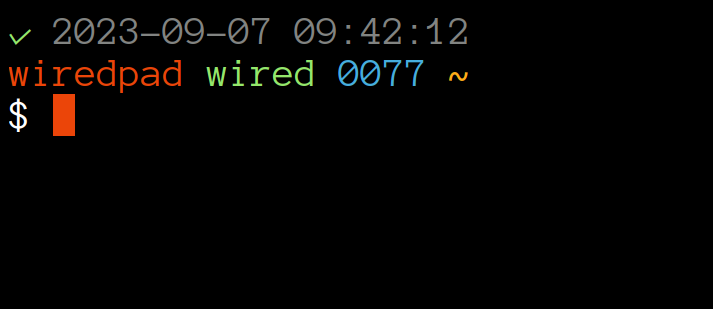
To improve the situation I decided to use a two line prompt. On the first line I have the current host, user and path with different colors, while on the second line I have nothing but the actual command prompt.
This way I can easily tell what system I’m on, what user I’m logged in as and what directory I’m in at a glance. I also have lots of space for my commands since the path doesn’t get in my way.
Here’s how it looks like:

To change your prompt when using bash, edit your ~/.bashrc file
(make sure you source ~/.bashrc in ~/.bash_profile, or just edit that file instead)
and add the following
export PS1="\[\033[01;31m\]\h\[\033[00m\]\[\033[01;32m\] \[\033[01;32m\]\u \[\033[00;33m\]\w\n\[\033[01;30m\]$ \[\033[00m\]"
You may also run the above line in your shell to test it without making it permanent.
legend:
\h = host
\u = user
\w = current path
\n = new line
$ = $
the rest is color codes, for example [\033[01;31m\] = red
tags:
bash,
bash prompt,
config,
configuration,
prompt,
shell,
shell prompt posted in
configs by wired |
2 Comments
urxvt is my favorite termimal
It renders fonts nicely, supports unicode and has various other interesting features.
I’ve also configured it to open links on mouse click!

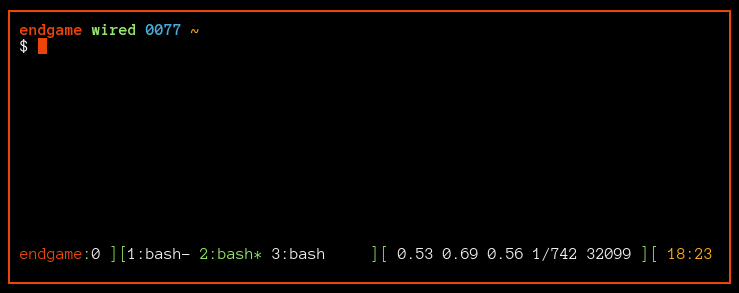
To configure urxvt to look like the above screenshots, add the following in your ~/.Xdefaults file:
URxvt*loginShell:true
URxvt*transparent:true
URxvt*shading:5
URxvt*background:Black
URxvt*foreground:White
URxvt*scrollBar:true
URxvt*scrollBar_right:true
URxvt*scrollBar_floating:false
URxvt*scrollstyle:plain
URxvt*secondaryScroll:true
# how many lines you want it to save per session
URxvt*saveLines:32767
URxvt*troughColor:#000000
URxvt*scrollColor:#222222
URxvt*font: xft:Dejavu Sans Mono:pixelsize=11
# with this set to true, when an app sends a bell to the terminal, awesome hilights the appropriate tag(s) 
URxvt*urgentOnBell: true
# these three lines enable clicking on links to open them 
## if you want to enable tab support, append ,tabbed to the next line
## then use shift+down arrow to create tabs and shift+{left,right} arrows to switch between them
URxvt*perl-ext-common: default,matcher,-option-popup,-selection-popup,-realine
URxvt*matcher.button: 1
# don't forget to change this to your favorite browser
URxvt*urlLauncher: chromium
enjoy!
tags:
config,
configuration,
terminal,
urxvt posted in
configs by wired |
8 Comments
update: I’ll be adding links next to the apps each time I post a guide
I’ve decided to document the configuration of the apps I use most in blog posts
Maybe someone will find them useful!
Some of the apps (linked to their homepages):
awesome (+ conky)
tmux
mutt
irssi
urxvt – view post
quicky: my shell prompt (view)
I’ve created a separate category called configs where you’ll find all the related posts!
posted in
configs by wired |
No Comments
I’ve added ebuilds in Gentoo’s portage for a new webkit browser called luakit.
[I] www-client/luakit
Available versions: (~)2010.08.07 (~)2010.08.13 **9999
Homepage: http://www.luakit.org
Description: a webkit-gtk based, micro-browser framework in Lua
It is a webkit based, low footprint browser written in C and Lua, modeled after awesome wm, my favorite window manager
Vim-like bindings, low memory usage, lua configuration file (if you use awesome you will feel at home) and rapid development are some of luakit‘s key points.

To try it out:
emerge -av luakit
(~testing only, so you have to keyword it if running stable)
For more information, visit the luakit website, or join #luakit (OFTC IRC network)
tags:
browser,
gentoo tree,
luakit,
webkit posted in
gentoo,
luakit by wired |
3 Comments
I’m a nominee for the upcoming Gentoo Council (thanks Markos
).
To help developers decide if they want to vote for me, I wrote a short manifesto. It follows:
swift. decisive. vigilant. for an even better Gentoo!
---
this year I've decided not to write a long, tiresome manifesto.
there is no point in making promises for things that may never even reach the
council's umbrella.
besides, in reality almost everything landing on the council's agenda is
dynamically decided by the developers a few days or weeks before meetings
and council members need to be swift, decisive and always vigilant to be able
to resolve things quickly and efficiently, even from the shadows, if possible.
these three words pretty much describe my "running for council" manifesto:
swift, decisive, vigilant.
Gentoo deserves nothing less
---
who am I:
Alex Alexander, 26yo, currently working as a web developer.
Qt Project Lead, KDE Project Member, maintainer of various other packages.
--
wired
tags:
council,
gentoo,
gentoo council,
manifesto posted in
gentoo by wired |
6 Comments